Few garments have carried such contrasting meanings as the pinstripe suit. At various points in its history, it has represented discretion, power, rebellion, and authority — worn by both those enforcing the rules and those determined to bend them.
Its journey from nineteenth-century London to global cultural symbol is one of quiet evolution rather than sudden reinvention.
A Language of Work and Identity
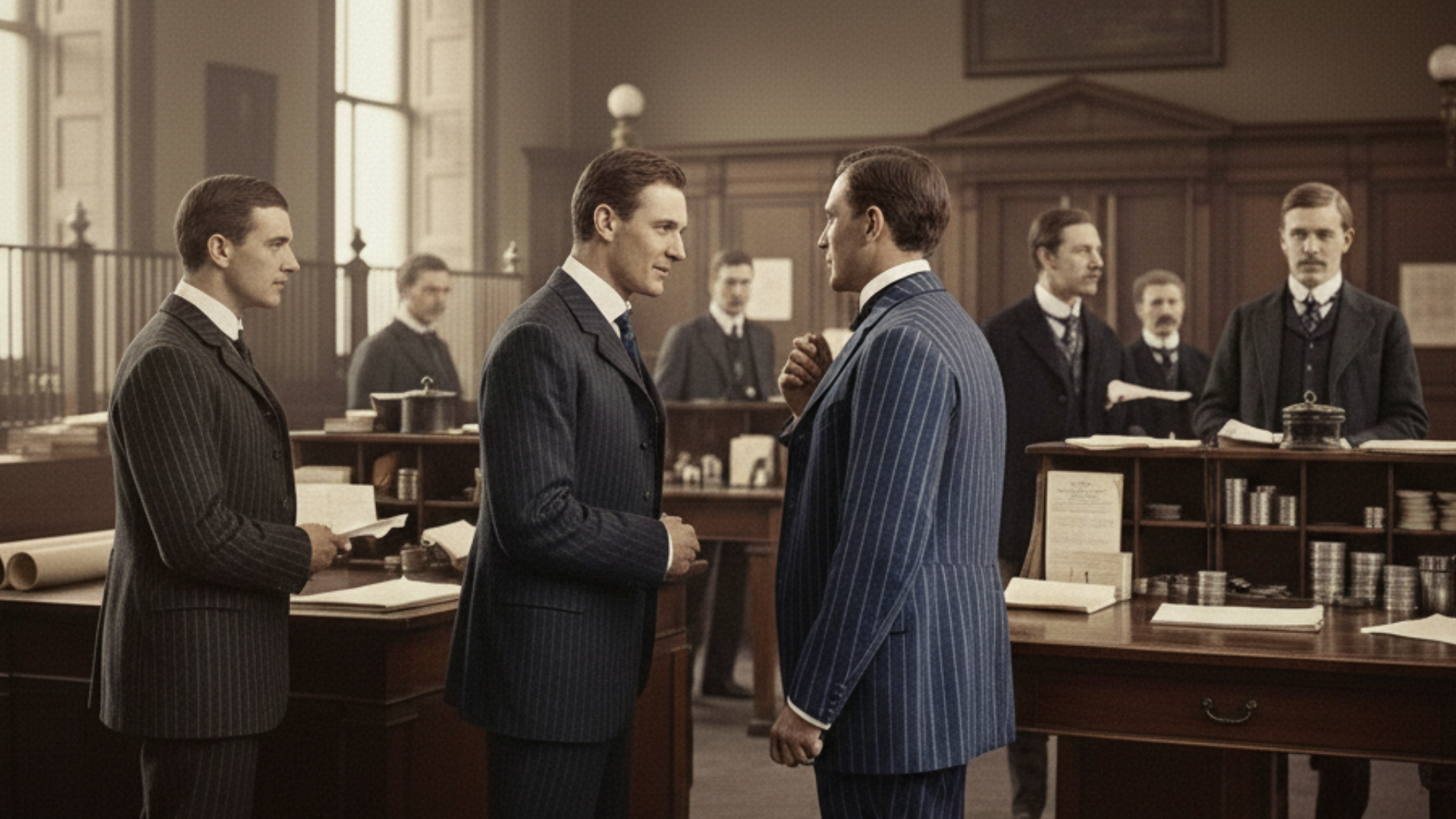
The pinstripe suit first appeared in nineteenth-century London, rooted firmly in the world of finance. In an era long before digital identification or security passes, clothing played a more practical role in signalling who belonged where.
Within the banking houses of the City, pinstripes functioned almost as a form of code. Each institution developed its own variation — subtle differences in stripe width and spacing that identified its employees. A clerk from the Bank of England would wear a stripe distinct from one associated with another firm. To the untrained eye, the differences were invisible; to those in the know, they were unmistakable.
There is also a competing theory that links pinstripes to the sporting culture of Victorian England. Rowing and boating were hugely popular at the time, and striped uniforms were common among participants. This association may explain why early pinstripes felt slightly bolder and more expressive than plain black or charcoal suits — formal, but with an edge.
Crossing the Atlantic
When the pinstripe arrived in the United States in the early twentieth century, it shed much of its reserved English identity.
During the Prohibition era of the 1920s and 1930s, the pinstripe suit became synonymous with ambition and excess. Bootleggers and organised crime figures adopted it deliberately, using the language of business attire to project legitimacy and status. Wider, more dramatic stripes — often referred to as chalk stripes — allowed them to stand out while still appearing respectable.
At the same time, Hollywood amplified the pinstripe’s appeal. Actors such as Cary Grant and Clark Gable wore it with effortless confidence, reinforcing its association with masculine elegance. On screen, the pinstripe was no longer merely professional — it was aspirational.
Even during the austerity of the Second World War, the pattern retained its authority. Winston Churchill famously wore a pinstripe “siren suit,” demonstrating that the motif could signal resolve and leadership even outside conventional tailoring.

The Power Suit Era
The pinstripe’s next major resurgence came in the 1980s, returning to its financial roots but in a far more assertive form.
This was the age of the power suit: broad shoulders, strong lines, and unapologetic presence. The pinstripe became the visual shorthand for ambition and dominance, immortalised by characters such as Gordon Gekko in Wall Street. The suit was no longer simply about fitting in — it was about being seen.
Women, too, adopted the pinstripe during this period, using its sharp vertical lines as a tool for authority in male-dominated environments. The pattern’s ability to convey confidence and structure transcended gender.
A Modern Reinterpretation
Today, the pinstripe suit is no longer confined to boardrooms or formal settings. Designers and wearers alike have softened its image, allowing it to move fluidly between tailoring, streetwear, and high fashion.
Pinstripe blazers now appear layered over casual clothing, while wide-legged pinstripe trousers are worn with ease rather than rigidity. The pattern has also been reimagined across genders, with exaggerated silhouettes, unconventional colours, and playful proportions challenging its traditional associations.
What remains consistent is the pinstripe’s ability to communicate intent. Whether subtle or bold, it still carries meaning.

A Note on Craft
Technically speaking, a true pinstripe is created from tiny pinhead-sized dots of yarn arranged in a vertical line. A chalk stripe, by contrast, is wider and appears almost as though drawn with a piece of tailor’s chalk. The distinction is small, but in tailoring, such details matter.
Enduring Appeal
The pinstripe suit has survived because it adapts without losing its identity. It can suggest authority or individuality, tradition or defiance — depending entirely on how it is cut, worn, and understood.
Like all enduring garments, its power lies not in novelty, but in nuance.